A meadow in late June can feel like an exam you haven't revised for. Yellow, white and purple flowers all at once, most of them around knee height, and a field guide that seems to assume you already know the answer. Identifying wildflowers isn't really about memory. It's about noticing the same few things over and over, then returning to the same patch of ground as the season turns. The twenty species below are widespread, reasonably distinctive, and will carry you from April through to September.
Four Clues That Do Most of the Work
Before you worry about names, get into the habit of asking four questions. Most beginner identification goes wrong because the flower gets examined closely and everything else is ignored.
- Flower shape and arrangement – a spike, a flat umbel, a daisy-like head, a pea flower, a bell, a pincushion. Shape narrows the field faster than colour.
- Leaves – opposite or alternate along the stem, hairy or smooth, lobed, narrow or feathery. Take a photo of a leaf as well as the flower.
- Habitat – woodland, hedge bank, damp grassland, hay meadow, disturbed arable soil. A plant out of place is usually a misidentification.
- Timing – a bluebell in August is almost certainly not a bluebell.
Add one more habit: photograph from three angles. Face-on for the flower, side-on to show whether it nods or sits upright, and a close shot of a leaf and stem. Include your hand or boot for scale.
If you only remember one thing, remember this: the common name is a starting point, not a diagnosis. Always check the leaves and the habitat before you commit.
Spring: Woodland and Hedge-Bank Flowers
Bluebell (Hyacinthoides non-scripta) – April to May in woodland. Nodding deep violet-blue bells hanging mostly on one side of the stem, above narrow strap-like leaves. Native bluebells have cream-coloured anthers; the Spanish bluebell is paler, more upright, with flowers all round the stem. If you find a bluebell with a mix of features, it may be a hybrid – these are increasingly common.
Cowslip (Primula veris) – April to May on unimproved grassland. Clusters of small, deep yellow, nodding flowers on a single hairy stem. Brighter and more clustered than a primrose, which flowers singly. Cowslips are a good indicator of old, undisturbed meadows, so finding them is a small piece of local history.
Greater stitchwort (Stellaria holostea) – April to June in hedgerows. White flowers with petals notched so deeply that a five-petalled flower looks like ten. Straggly, thin, grassy leaves. It often scrambles through other vegetation, so look for the starry flowers rather than a neat clump.
Bugle (Ajuga reptans) – late spring on damp ground. Short spikes of deep blue flowers above glossy, often bronze-tinged leaves. It spreads by runners, forming loose carpets in damp woodland rides and wet meadows.
Red campion (Silene dioica) – May to September on hedgebanks and woodland edges. Five pink petals, each notched, with hairy leaves in opposite pairs. It is dioecious, meaning male and female flowers grow on separate plants – the female flowers have longer, more prominent styles.
Cow parsley (Anthriscus sylvestris) – April to June on verges. Flat, lacy white umbels on ridged stems with ferny leaves. Lovely, and easy to confuse with relatives – see below for the umbellifer warning.
Early Summer: Daisies, Poppies and a Sea of Yellow
Oxeye daisy (Leucanthemum vulgare) – June to September in hay meadows. Bigger and taller than a lawn daisy, with one flower per long stem, white rays around a yellow disc, and spoon-shaped lower leaves with lobed edges. A classic meadow flower that has declined with agricultural improvement.
Meadow buttercup (Ranunculus acris) – May to July in damp meadows. Upright, with finely divided leaves and glossy yellow petals. Creeping buttercup is shorter, spreads by runners, and has blotchy, less divided leaves. To tell them apart, look at the sepals: meadow buttercup has spreading sepals, creeping buttercup has reflexed (bent back) sepals.
Common poppy (Papaver rhoeas) – June to August on disturbed arable land and field edges. Scarlet, four thin petals often blotched black at the base, hairy stems, and buds that nod before opening. Poppies need bare soil to germinate, so they appear in profusion after ploughing or on set-aside land.
Bird's-foot trefoil (Lotus corniculatus) – June to September in short grass. Low-growing yellow pea flowers streaked with orange-red, often in clusters of three to seven, and leaves with five leaflets (three at the tip, two at the base). The seed pods curve like a bird's foot, hence the name.
Foxglove (Digitalis purpurea) – June to August in woodland clearings and heathland. Tall spikes of purple-pink tubular flowers, spotted inside, with soft, downy leaves. All parts are toxic, so admire but don't pick.
Common knapweed (Centaurea nigra) – June to September in meadows and verges. Purple thistle-like flower heads with a swollen, dark brown base covered in overlapping scales. The flowers are a magnet for bees and butterflies.
High Summer: Purple, Pink and Powdery
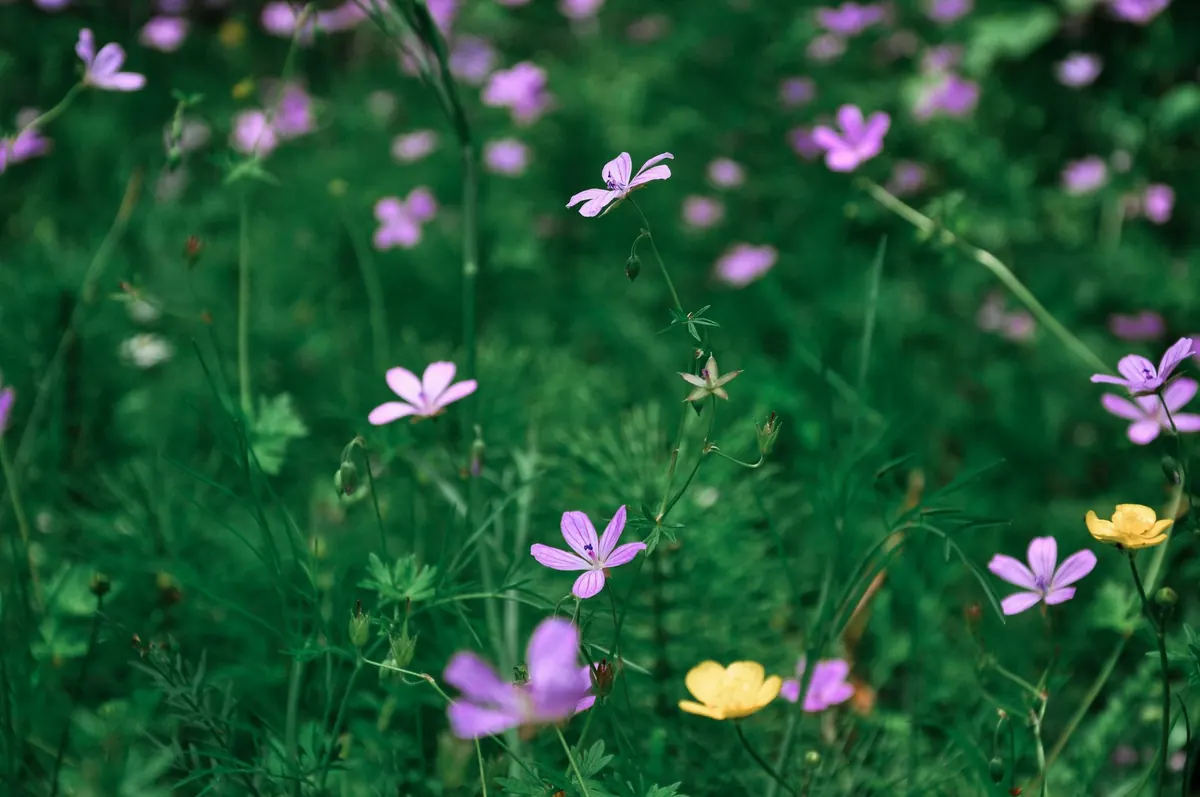
Meadow crane's-bill (Geranium pratense) – June to August in old meadows. Large, saucer-shaped violet-blue flowers with five petals, deeply divided leaves, and distinctive beak-like seed pods. It is one of our most beautiful wild geraniums.
Lady's bedstraw (Galium verum) – June to September in dry grassland. Tiny, four-petalled yellow flowers in frothy clusters, with narrow, whorled leaves. It smells faintly of honey, and was once used to stuff mattresses.
Selfheal (Prunella vulgaris) – June to September in lawns and short grass. Compact, egg-shaped heads of violet-blue flowers above a pair of leaves. It is low-growing and easily overlooked, but once you see it, you'll spot it everywhere.
White clover (Trifolium repens) – May to September in lawns and pastures. Round heads of white, sometimes pink-tinged, pea flowers, with the classic three-leaflet clover leaves. The leaflets often have a pale V-shaped mark.
Yarrow (Achillea millefolium) – June to September in grassland and verges. Flat-topped white or pinkish flower heads, and finely divided, feathery leaves. It has a strong, slightly medicinal smell when crushed.
Late Summer and Wasteland
Spear thistle (Cirsium vulgare) – July to September on disturbed ground. A tall thistle with spiny, winged stems and large purple flower heads. The leaves are deeply lobed and prickly – handle with care.
Common ragwort (Jacobaea vulgaris) – July to September on waste ground and verges. Bright yellow, daisy-like flowers in flat-topped clusters, with deeply lobed leaves. It is toxic to livestock, but it supports a huge number of insects, including the striking cinnabar moth caterpillar.
Hogweed (Heracleum sphondylium) – June to September in hedgerows and rough grassland. Large, flat umbels of white flowers, often with a pinkish tinge, on stout, hollow stems. The leaves are broad and divided, quite different from cow parsley.
The Umbellifer Warning
Cow parsley, hogweed and several other members of the carrot family (Apiaceae) have flat, white flower heads that look superficially similar. This is the group where beginners can get into real trouble. Some umbellifers are seriously toxic, including hemlock (Conium maculatum) and hemlock water dropwort (Oenanthe crocata), which can be fatal if eaten.
How to stay safe? First, never eat any wild umbellifer unless you are with an expert. Second, check the stems and leaves. Hemlock has purple blotches on a smooth, hollow stem and a mouse-like smell. Cow parsley has ridged, slightly hairy stems and a pleasant parsley scent. Third, look at the habitat. Hemlock water dropwort loves wet ditches and streamsides; cow parsley prefers drier verges and hedge banks.
If in doubt, leave it out. A photograph and a field guide are safer than a taste test.
Making Identification Stick
The best way to learn wildflowers is to return to the same patch of ground every week or two. You will see the same plants change – buds open, leaves expand, seed heads form – and that familiarity does more than any flashcard. Keep a simple notebook: date, place, flower colour, leaf shape, and a quick sketch or photo. Over a season you will build your own local field guide.
Use apps and online groups as a second opinion, but always check the key features yourself. A good question to ask is: "What else could this be?" If you can rule out the lookalikes, you are on solid ground. Start with the twenty species here, and by September you will be surprised how many names come without thinking.
Photo: Henry Wagner / Pexels